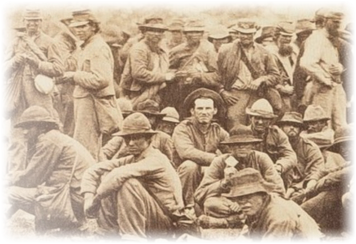
Point Lookout Bios of Notable Prisoners and Guards
A sample of some of the bios contained in the book
Confederate Prisoners
Union Guards
Private Martin Alonzo Haynes
Co I, 2nd New Hampshire Infantry
Private Stanley J Morrow
20th Veteran Reserve Corp / 7th Wisconsin
2nd Lt Erastus Everson Watson
20th Veteran Reserve Corp
Sergeant James William Thomas
Co A, 2nd Maryland Infantry CSA
Born on April 2, 1840, James William Thomas was the youngest of three brothers of a well-rooted
and influential southern Maryland family. They would own four plantations in St. Mary’s County
and one in neighboring Calvert County. His ancestry would include William Thomas Sr and Jr.,
both served as Majors in the Maryland Line during the American Revolution while one
grandfather, Dr. James Thomas, would become Governor of the State of Maryland from 1833 to
1836.
All
three
would
enlist
in
the
2
nd
Maryland
on
June
19,1861.
The
oldest
brother
of
the
three,
Richard,
had
added
the
name
Zarvona
to
his
name
forming
“Zarvona’s
Zouaves.”
Richard
and
his
men
captured
a
Union
vessel
with
Thomas
disguising
himself
as
a
French
woman.
He
was
arrested
during
a
second
attempt
to
capture
another
Union
ship,
resulting
in
his
spending
time
in
a
Union
prison.
The
second
oldest,
George,
was
promoted
to
Captain
in
the
2
nd
Maryland
Infantry
and
wounded
twice
(Gettysburg
and
Cold
Harbor).
James
participated
in
the
Battles
of
Second
Winchester,
Gettysburg,
Cold
Harbor,
and
the
Siege
of
Petersburg.
His
distinction
in
this
article
is
that
he
would
become
a
prisoner
held
at
Point
Lookout,
not
once, but twice.
James
would
make
his
first
trip
as
prisoner
of
war
to
Point
Lookout
on
August
24,
1864,
after
having
been
captured
at
Petersburg.
He
would
soon
reside
with
several
fellow
prisoners
from
the
2
nd
Maryland.
A
long-time
friend,
Sergeant-Major
William
(Billy)
Laird
of
the
2
nd
Maryland
would
be appointed Sergeant-Major of the prison camp.
The
Thomas
family
were
residents
of
St.
Mary’s
County
living
approximately
twenty-five
miles
or
so,
north
of
Point
Lookout.
As
a
result,
James
was
soon
in
correspondence
with
his
mother
and
sister
informing
them
of
his
incarceration
at
the
prison.
In
no
time,
he
was
receiving
food
and
cash from his family and any other necessary items needed for a prisoner to survive prison life.
James
was
apparently
of
a
good
heart
and
shared
much
of
his
wealth
with
his
fellow
prisoners.
As
a
result,
they
had
purchased
the
necessary
construction
materials
to
improve
their
shelter
converting
it
into
a
“cracker
box
house”
on
what
was
known
as
“cracker
box
row”
(also
referred
to
as
“Maryland
Avenue”
due
to
the
fact
that
many
prisoners
from
Maryland
resided
on
this
street
in
the
prison).
It
was
stated
by
other
prisoners
that
those
fellow
inmates
from
Maryland
had
a
more
tolerable
existence
at
Point
Lookout,
as
they
had
easier
access
to
their
families
and
friends.
This
evidently
was
the
case
with
James.
His
mother
and
sister
were
permitted
to
visit
as
well
as
to
send
food,
cash,
and
clothing
to
him
after
plying
the
provost
marshal
with
a
ham
or
a
turkey
every
now and then.
James
was
exchanged
in
March
1865
only
to
be
recaptured
a
few
weeks
later.
As
federal
forces
breached
the
Confederate
works
defending
Petersburg,
Thomas
was
once
again
made
a
prisoner
of
war
on
April
2,
1865.
He
would
return
to
Point
Lookout
on
April
3
rd
,
much
to
the
amusement
of
some
of
the
guards
who
recognized
him.
James
was
finally
released
by
taking
the
Oath
of
Allegiance
on
May
26,
1865.
James
William
Thomas
was
one
of
the
few
prisoners
from
Point Lookout that would walk home from Point Lookout.
After
the
war,
he
would
leave
St.
Mary’s
County
to
become
a
civil
engineer
in
Baltimore
for
a
few
years.
He
eventually
returned
to
St.
Mary’s
County
and
purchased
a
farm
on
Indian
Creek
near
Benedict,
Maryland.
James
Thomas
was
severely
injured
during
an
accident
on
his
farm
passing
on
December
21,
1901,
at
the
age
of
61
as a result of his injuries.


Click on name to view bio
Left: Grave site of James William Thomas, All Faith Episcopal Church
Cemeter, Mechanicsville, Maryland.
https://www.findagrave.com/memorial/18138767/james-william-
thomas
Private Martin Alonzo Haynes
Company I, 2nd New Hampshire Volunteer Infantry
On
the
sultry
afternoon
of
July
31,
1863,
the
remnants
of
the
2nd
and
12th
New
Hampshire
Infantry
regiments
arrived
at
the
wharf
at
Point
Lookout.
Their
journey
was
brief
traveling
down
the
Potomac
river
from
Washington
city.
They
had
been
there
before
in
1862
on
their
way
to
what
would
be
known
as
the
Peninsular
Campaign,
in
Virginia.
Their
transport
boats
made
a
brief
layover
for
a
few
hours
to
take
on
water
for
the
crew
and
the
ships
boilers.
However,
this
time, the visit would not be as brief as that of the year before.
Arriving
with
their
personal
and
regimental
baggage
came
136
prisoners
of
war
who
would
be
the
first
to
be
incarcerated
at
the
new
prison
located
in
southern
Maryland.
The
two
veteran
regiments
barely
mustered
300
men
together
after
having
taken
devastating
losses
earlier
in
July
defending
a
Peach
Orchard
on
a
rise of ground, at the Battle of Gettysburg.
General
Gilman
Marston,
the
former
colonel
of
the
2nd
regiment,
now
the
commanding
officer
of
Point
Lookout,
arranged
to
cobble
together
an
ad-hoc
brigade
of
all
New
Hampshire
men
whom
he
managed
to
have
detailed
to
the
recently
opened
prison
at
Point
Lookout.
It
was
ordered
that
they
remain
there
until
their
ranks
were
replenished
with
new
recruits
after
which,
they
were
to
be
returned
to
the
Army
of
the
Potomac.
Private
Martin
Haynes
would
be
one of the fortunate survivors to arrive at Point Lookout that hot summer day.
Prior
to
the
war,
Martin
Haynes
was
a
printer’s
apprentice
at
a
print
shop
in
his
home
town
of
Manchester,
New
Hampshire.
Martin
was
a
boy
of
nineteen
when
he
answered
his
State’s
call
for
volunteers
in
June
1861
enlisting
into
the
much-venerated
2nd
New
Hampshire
Volunteer
Infantry.
The
2nd
New
Hampshire
would
serve
in
many
of
the
early
battles
of
the
war
up
to
their
transfer
to
Point
Lookout
moving
from
there
to
General
Grant’s
Overland
Campaign.
He
survives
the
war
mustering out with his regiment shortly after the Battle of Cold Harbor in June 1864.
In
the
post-war
years,
Haynes
would
write
the
regimental
history
for
the
2nd
New
Hampshire
Association,
once
in
1865
followed
by
a
revised
second
edition
in
1896.
Haynes,
a
prolific
letter
writer,
wrote
many
letters
to
his
fiancé’
(who
would
become
his
wife
in
June
1863),
throughout
his
time
in
the
army.
Fortunately,
for
future
researchers,
his
wife
kept
his
wartime
letters.
Haynes
would
take
these
letters
and
publish
them
under
the
title,
“A
Minor
History
Compiled
From
a
Soldier Boy’s Letters to the Girl I Left Behind Me”
in 1916.
Private Stanley J. Morrow
20th Veteran Reserve Corp
Stanley
J.
Morrow
was
transferred
to
Point
Lookout
in
May
1864
as
a
soldier
in
the
20
th
Veteran
Reserve
Corps.
Morrow,
who
had
been
wounded,
was
a
drummer
from
the
7
th
Wisconsin
Infantry
of
the
Iron
Brigade.
His
skill
as
a
musician
placed
him
in
the
regimental band of the 20
th
V.R.C.
Even
though
the
circumstances
are
unknown,
Morrow
soon
found
himself
under
the
tutelage
of
Matthew
Brady,
who
established
another
image
gallery
at
Point
Lookout.
Morrow
became
an
assistant
at
this
gallery
and
soon
began
offering
his
services
as
a
photographer
to
both
Union
and
Confederate
soldiers.
As
evidenced
by
some
of
the
subject
matter
of
Morrow’s
images,
his
gallery
was
most
likely
located
near
the
army
hospital
area.
Regardless
of
the
identity
of
his
mentor,
Morrow’s
images
of
the
camp
buildings,
prisoners,
the
staff,
and
members
of
the
garrison
have
often
appeared
in
various
publications,
depicting
much
of
Point Lookout.
Morrow
was
mustered
out
of
the
service
September
1,
1864,
and
returned
to
Wisconsin.
In
1866.
Morrow
married,
and
the
couple
would
head
west,
settling
in
Yankton,
South
Dakota
territory,
soon
opening
a
photographic
studio.
Morrow
would
lead
a
distinguished
career
capturing
some
of
the
most iconic photographs of the West and those of American Indians.
In
1876,
Morrow
had
obtained
permission
from
Lieutenant-Colonel
George
Custer
to
accompany
him
and
the
7
th
Cavalry
on
their
ill-fated
expedition
against
the
Sioux.
Fortunately
for
Morrow,
he
would
miss
leaving
Fort
Abraham
Lincoln
with
Custer
and
the
7
th
due
to
the
tardy
arrival
of
his
ordered
photographic
chemicals,
which
arrived
after
Custer’s
departure.
Due
to
this
delay,
Morrow
missed
riding
into
history
with
Custer
and
his
men.
However,
he
would
eventually
become
the
official
photographer
for
the
command
of
General
George
Crook
after
the
Battle
of
the
Little
Big
Horn
and
photograph
much
of
the
campaign,
including
the
initial
recovery
and
burial
expedition
in
1877 for those soldiers slain at the Little Big Horn.
Stanley J. Morrow. A Civil War Photographer at Point Lookout, Maryland. Gerald J. Sword. Chronicles of
St. Mary’s. Monthly Bulletin of the St. Mary’s County Historical Society. Vol. 31. No. 12. December 1983,
105.
Erastus W. Watson
20th Veteran Reserve Corp.
Erastus
W.
Watson
entered
the
rolls
as
a
private
of
the
3
rd
Massachusetts
Infantry
on
April
16,
1861.
He
would
later
re-enlist
as
sergeant
joining
the
ranks
of
the
18
th
Massachusetts
Infantry
and
was
soon
promoted
to
2
nd
Lieutenant.
He
was
wounded
twice;
once
in
August
1862
at
the
Battle
of
2
nd
Manassas
and
again
at
the
Battle
of
Fredericksburg
in
December
of
the
same
year.
He
was
soon
promoted
to
1
st
Lieutenant
in
February
the
following
year.
Because
of
the
physical
restrictions
caused
by
his
wounds,
Watson
successfully
applied
for
transfer
to
the
Veteran
Reserve
Corps
(VRC).
He
received
his
assignment
to
the
20
th
VRC
in
early
1863,
receiving
brevet
ranks of Captain and Major during his enlistment.
In
mid-May
1864,
the
20
th
VRC
was
transferred
to
Point
Lookout
for
guard
duty.
Fortunately
to
the
benefit
of
his
family
and
future
researchers,
Erastus
was
a
prolific
letter
writer
who
wrote
regularly
to
his
mother
in
Massachusetts.
In
his
letters,
he
describes
what
life
was
like
while
on
duty
at
Point
Lookout.
In
addition
to
his
letters,
Watson
also
kept
a
diary
filled
with
endnotes
and
anecdotes
accompanied
by
an
additional
edition
of
notes
and
comments.
As
redundant
as
this
may
seem,
all
were
important
as
one
tended
to
be
more
descriptive
than
the
other
as
if
he
were
writing
to
different
levels
of
readers.
While
serving
at
Point
Lookout,
Watson
performed
the
duties
as
adjutant
to
the
20
th
VRC,
and
performed
the
various
other
duties
as
required
of
an
officer
of
the
command.
Ironically,
Watson
served
under
the
last
of
a
succession
of
commanding
officers
at
Point
Lookout,
Brigadier
General
James
Barnes.
Prior
to
his
promotion
to
Brigadier
General,
Barnes
had
served
as
the
Colonel
commanding
the
same
18
th
Massachusetts
Infantry
that
Watson
had
served.
Both
would renew their acquaintance while at Point Lookout.
During
the
post-war
years,
Watson
would
serve
on
the
Freeman’s
Bureau
in
Charleston,
South
Carolina,
and
the
U.S.
government
in
the
revenue
service.
At
age
59,
Watson
died
suddenly
of
heart
failure
on
January
6,
1897.
Major
Erastus
W.
Everson
is
buried
in
Mount
Pleasant
Cemetery,
Pembroke, Massachusetts.


Copyright © 2026 Robert E Crickenberger
Point Lookout, Maryland
The Largest Civil War Prison
By Robert E. Crickenberger, Jr.
A Groundbreaking Book
That Rewrites the Legacy of
the Unions Most Infamous POW Camp
July 1863 - August 1865